
Checking Criminal History in Hancock County
A sound Hancock County criminal history search starts with a full name and any exact date of birth that the requester may lawfully use. Search spelling variants as well. The free Iowa Courts Online Electronic Docket Record Search is the broad first stop for filed Iowa cases. Select Hancock County and compare the case title, type, dates, and charge information. A name match alone does not prove identity.
Then follow the record to its source. Hancock County criminal records split among the arresting agency, jail administrator, court clerk, Division of Criminal Investigation, and Department of Corrections. Each answers a different part of the question.
- Search the free Iowa court docket by name, full case ID, or citation number and narrow the result to Hancock County.
- Check the sheriff's current roster when recent booking or custody is the concern.
- Ask the arresting agency for its incident report and the jail administrator for booking material.
- Visit the courthouse terminal or ask the clerk for pleadings, orders, judgments, or certified copies.
- Order a DCI Iowa record check when a repository-level history is needed, and use a signed release for a self-review.
Three Hancock County Record Systems
Iowa Courts Online, the Hancock County roster, and DCI do not duplicate one another. The court docket tracks filed charges, hearings, orders, dispositions, and financial events. The roster is a current custody list. DCI organizes fingerprint-supported Iowa arrest cycles with dispositions and correctional data reported to the state. A recent booking can appear before a court filing, while a court case can remain visible even when dissemination rules keep part of an old unresolved arrest out of an unsigned DCI response.
The portal choice should follow the question. Use the docket to understand a case, the roster to check present Hancock custody, and DCI to review releasable Iowa repository history. For sentenced prison or correctional supervision, use Iowa DOC Search Offenders. Federal cases and custody instead require the Northern District of Iowa, PACER, or the federal Bureau of Prisons.
| Official channel | Best use | Main limit |
|---|---|---|
| Iowa Courts Online | Filed Hancock County cases and docket events | Online index does not supply document images |
| Hancock roster | Current booking, charge, agency, and bond data | Not a historical arrest database |
| DCI record check | Releasable Iowa repository history | Not a national or federal court search |
| Iowa DOC Search Offenders | Prison and correctional supervision | Updates weekly |
Iowa Official Background Checks
The official state product is the DCI Iowa Criminal History Record Check. It uses a first name, last name, and exact date of birth. Middle name, gender, and Social Security number are optional aids for separating people with similar names. DCI accepts online, email, fax, mail, and walk-in requests, but not phone requests. The public fee is $15 for each last name searched.
A signed subject release matters. Without it, DCI withholds completed deferred judgments and arrests more than 18 months old when no final disposition has been received. The check covers Iowa data reported to DCI, not other states, FBI-only files, or federal court convictions. A no-record response can therefore mean no releasable record under that request, not a universal finding about the person.
| DCI request field | Required | Use |
|---|---|---|
| First and last name | Yes | Basic identity and separate fee for each last name searched |
| Exact date of birth | Yes | Required identity match |
| Middle name and gender | No | Helps separate similar names |
| Social Security number | No | Sensitive optional identity aid |
| Release signature | Conditional | Changes release of deferred judgments and old unresolved arrests |
| Billing and delivery fields | Yes as applicable | Sets payment and email, fax, mail, or walk-in return channel |
The official DCI page shown here identifies the forms, payment channels, and release rules used for a Hancock County criminal record check.
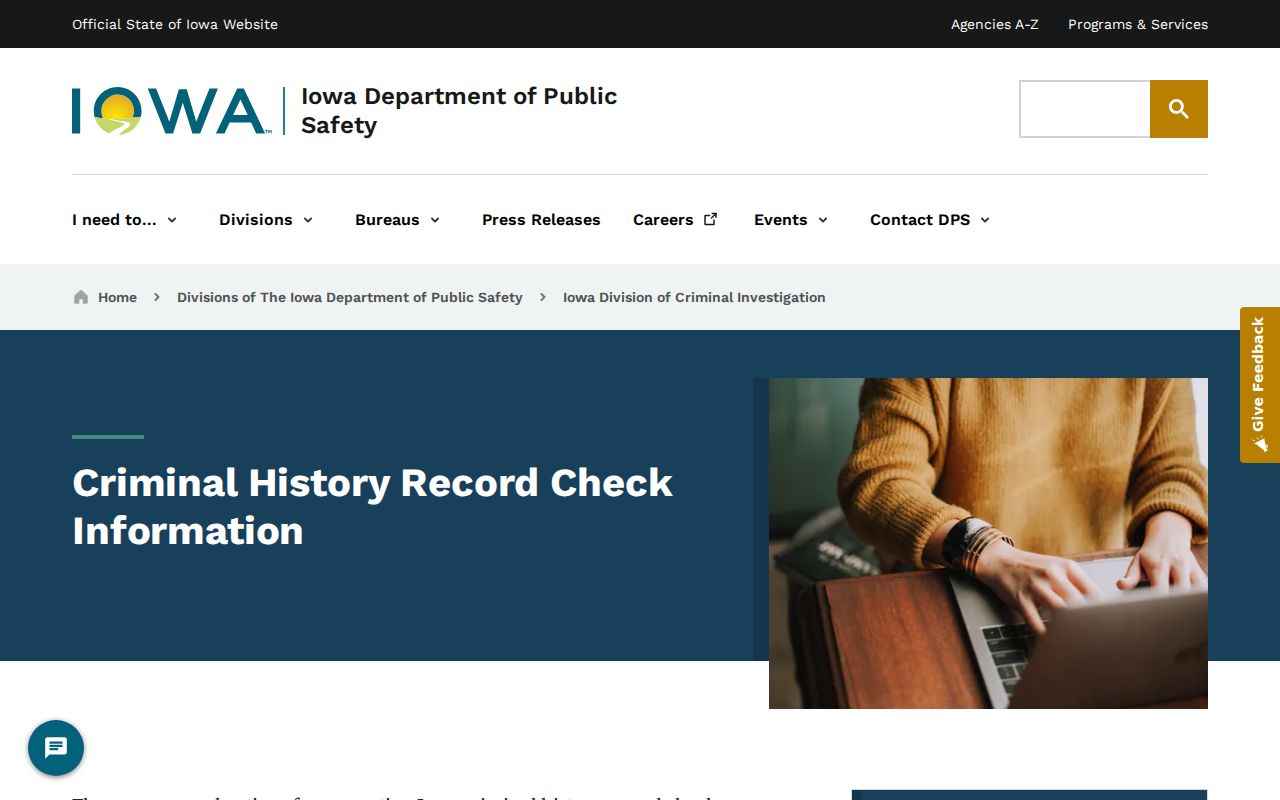
The state page is the source to consult before sending personal details because its instructions and processing estimates can change.
Hancock County Criminal Records Campus
The county's two chief counters sit next to each other in Garner but do different work. The Hancock County Courthouse at 855 State Street holds the clerk and County Attorney. The connected Law Enforcement Center at 875 State Street houses the sheriff and jail functions. Court pleadings and outcomes belong with the clerk. Sheriff-created incident, dispatch, booking, fingerprint, and jail records begin at the law enforcement building.
The county history page depicts the 1899 courthouse, which remains the center for Hancock County criminal court records.
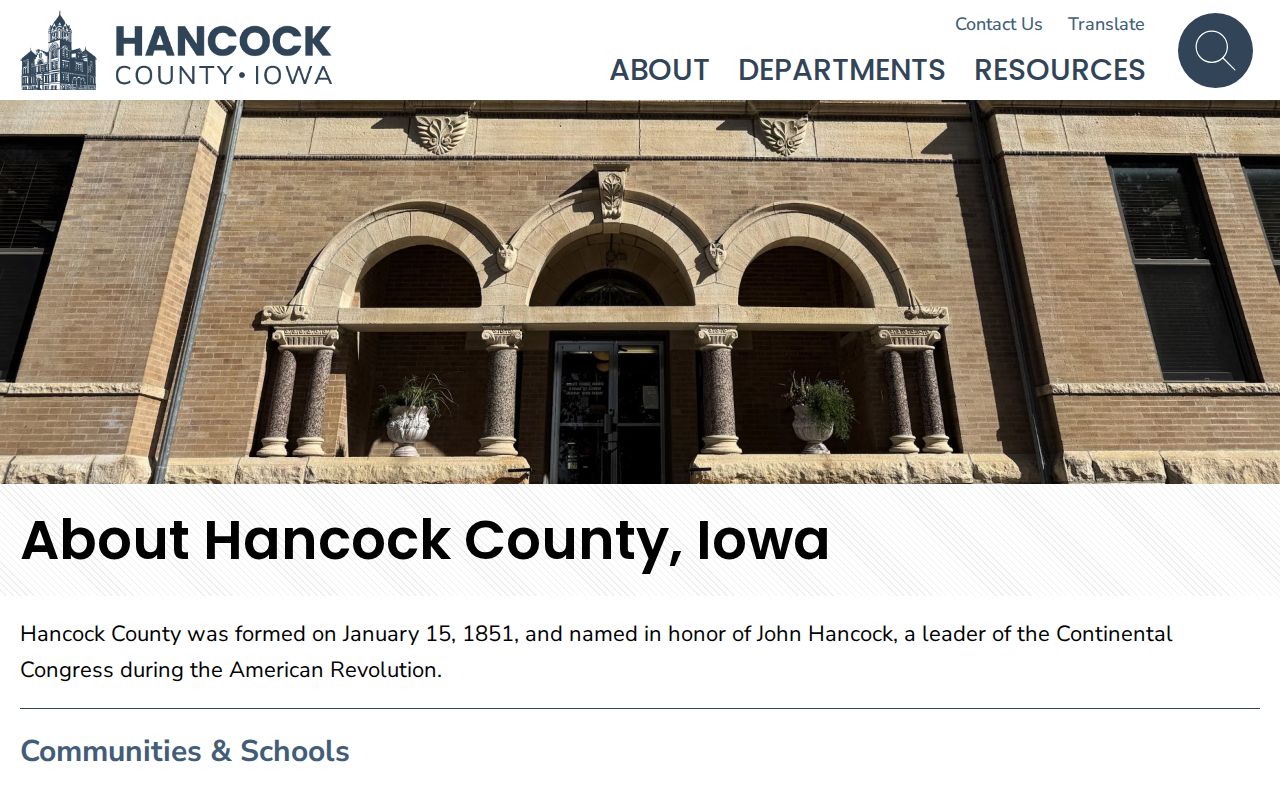
The county FAQ places the Clerk of Court on the second floor but describes fine payment on the third floor. Call before a trip rather than choosing one floor from that conflict. Both public offices list weekday hours of 8:00 a.m. to 4:00 p.m., excluding posted holidays.
Call the clerk at 641-923-2532 or the sheriff at 641-923-2621. Both publish weekday public hours of 8:00 a.m. to 4:00 p.m. The County Attorney is reached at 641-923-4198 and keeps weekday hours of 8:00 a.m. to noon and 1:00 to 4:00 p.m. That office prosecutes the case but is not the neutral source for a certified court copy.
Hancock County Criminal Record Types
One event creates several Hancock County criminal records. The police or sheriff writes the incident and arrest report. Intake creates a booking file. The County Attorney decides what state charges to pursue, and the Iowa District Court clerk opens the case. Fingerprintable arrest data and later court outcomes flow to DCI. Custody or supervision after sentence may appear in corrections systems.
Keep the custodian tied to the record. A booking entry proves that intake occurred, not that the charge ended in guilt. A complaint states an allegation. The docket shows how filed counts move. A DCI response is a repository summary rather than the full report or court file.
- Incident and arrest report: the creating law enforcement agency's account of the event and arrest basis.
- Booking record: jail intake, charge, agency, custody, release, and bond information.
- Court case file: complaints, formal charges, motions, orders, pleas, outcomes, and sentence.
- DCI history: releasable Iowa arrest cycles and reported court or corrections outcomes.
- Warrant or supervision entry: court and law enforcement warrant events or corrections status, subject to access limits.
Hancock County Booking Roster
The Hancock County jail page links the official current roster. That roster is a timestamped PDF, not a database. It has no search form, filter, account, or export tool. Scan the list or use the PDF viewer's find command, then note the timestamp before treating the entry as current. The public rows can show booking date and time, name, age, arresting agency, Iowa Code charge, a charge description, release field, and total bond.
The county arrangement has a key wrinkle. Since 2018, Hancock generally houses inmates at the Winnebago County Jail in Forest City even though Hancock keeps a certified jail and its own custody records. A person can therefore be recorded in Garner but sleep in Forest City. Call Jail Administrator Kevin Knebel at 641-923-2621 or 641-924-2148 when current placement or release needs confirmation. A blank release field is not a status guarantee.
The official sheriff page shown here identifies the law enforcement headquarters that keeps Hancock booking and jail records.

The sheriff remains the source for Hancock booking records even when physical detention occurs over the county line.
Inside a Hancock County Criminal Record
A Hancock County criminal record can combine identity information with one or more arrest cycles. A state rap sheet may include a legal name, aliases, birth date, state or FBI number, fingerprints, arrest date, agency, tracking number, charge, statute, and reported outcome. The public court file adds procedural detail. The roster supplies more immediate custody and bond data, but no final disposition.
Read one charge at a time. A dismissal on one count does not decide another count in the same case. Likewise, an arrest charge can change when the County Attorney files the formal case.
| Name and identifiers | Legal name, aliases, birth data, and agency identifiers where the record lawfully exposes them. |
|---|---|
| Arrest and booking | Event date, arresting agency, intake time, listed charge, release field, and bond data. |
| Charges and statutes | Offense text, Iowa Code citation, class or degree, and status for each count. |
| Disposition | Conviction, dismissal, acquittal, deferred judgment, or other charge-level result. |
| Sentence | Judgment, custody or probation terms, fines, costs, restitution, and later court events when public. |
| Custody or supervision | County booking, Iowa prison, probation, or parole information held by the responsible office. |
Hancock Arrests Reach Iowa DCI
The record flow starts with the Hancock County Sheriff, Garner Police, Britt Police, Kanawha Police, Iowa State Patrol, or another authorized agency. Fingerprintable arrest information moves to the Iowa Department of Public Safety, Division of Criminal Investigation. A separate booking record tracks custody. If prosecution follows, the County Attorney files or handles the charge and the Iowa District Court clerk maintains the docket.
Later, judicial outcomes are reported back to DCI, while custody and supervision data can arrive from the Iowa Department of Corrections. Delay can occur at each handoff. That is why a recent roster entry may precede a court case and why a DCI cycle may lack a final result until the court report reaches the repository.
Hancock record flow: Incident or arrest → Booking → Charging review → District Court case → Disposition → DCI and corrections updates.
The County Attorney's official office page illustrates the charging office within that chain.
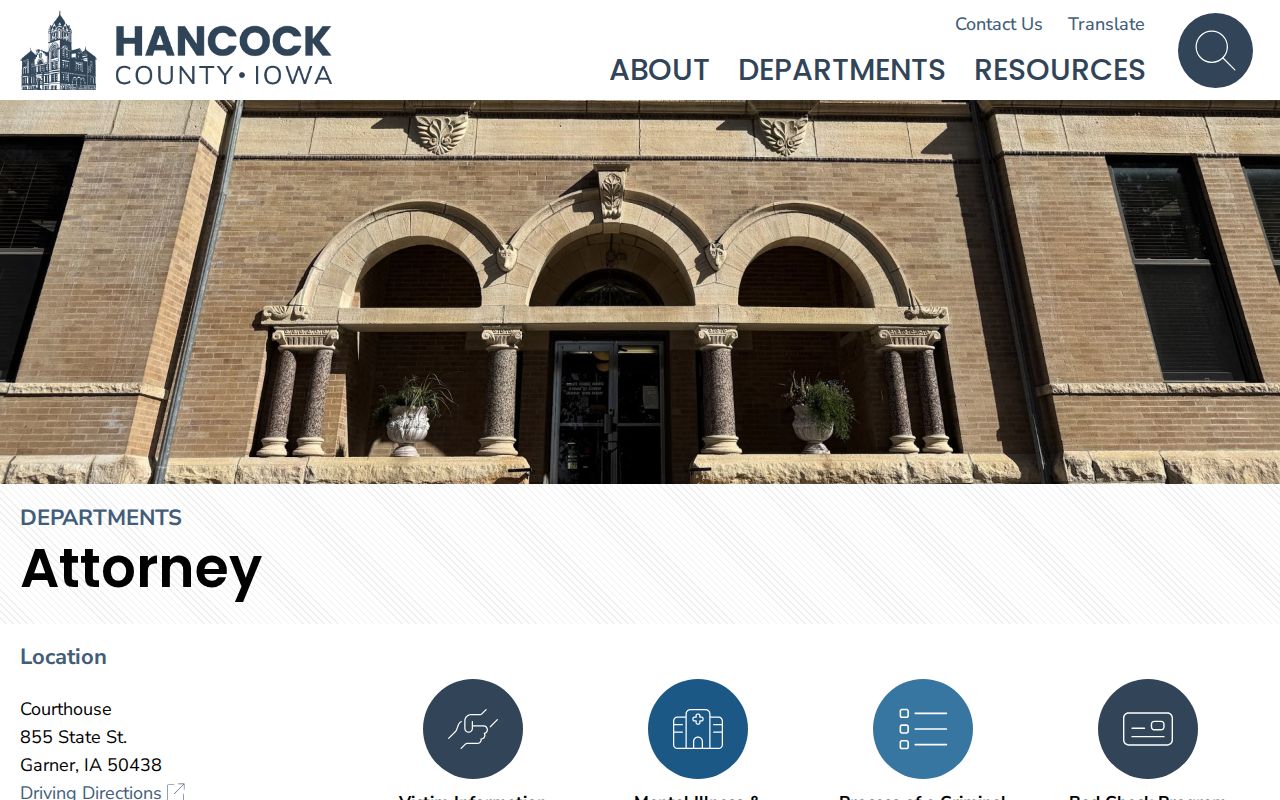
The prosecutor controls state charging decisions, while the clerk, police, sheriff, and DCI remain custodians of their own records.
Public Access Laws in Iowa
The Iowa Open Records Law begins with a right to examine and copy public records, but it does not make every criminal justice file open. Ask the office that lawfully keeps the material. The sheriff handles sheriff reports and booking data, a city handles its police reports, and the Judicial Branch handles court files. If a responsive file mixes public and protected content, ask for the segregable public portion.
Active investigative facts, juvenile material, protected victim details, medical information, Social Security numbers, and expunged court records may be withheld or redacted. DCI release rules are separate from a chapter 22 request. The source and status of a Hancock County criminal record determine the rule.
Key Iowa laws:
Iowa Code chapter 22 sets public examination, copying, cost, and confidentiality rules.
Iowa Code §§692.2 and 692.18 govern DCI dissemination and public treatment of criminal-history data.
Iowa Code §692.5 gives a record subject access, challenge, and review rights.
Iowa Code §§901C.2 and 901C.3 set the main expungement paths for qualifying cases.
Hancock County Warrant Checks
No official Hancock County public warrant database or most-wanted search was found. The inmate roster is not a warrant list. Start with the sheriff's continuous operations line at 641-923-2621, then check Iowa Courts Online for a docketed warrant or failure-to-appear event. The clerk at 641-923-2532 can help identify the case, while a city police department may hold the source record when its officer began the matter.
An arrest warrant authorizes custody. A bench warrant often concerns a missed court duty. A search warrant authorizes a search and may stay sealed during an inquiry. Do not appear without first confirming active status, the issuing court, bond terms, and instructions with the sheriff, clerk, or counsel. The sheriff's listed $35 civil warrant fee pays for civil service; it is not a warrant-search charge.
When no direct lookup resolves the question, a focused chapter 22 request can seek releasable information from the proper custodian. Sealed, juvenile, and investigative restrictions still apply.
Sealed, Expunged, and Restricted Records
Juvenile court material is generally confidential. Iowa law also protects specified victim data, medical information, personal identifiers, active investigative material, and records made confidential by court order or statute. An ordinary DCI response with no signed release also leaves out completed deferred judgments and old unresolved arrests under the state's dissemination rules.
Iowa Code chapter 901C provides outcome-specific expungement. Section 901C.2 addresses qualifying dismissed or not-guilty cases. Section 901C.3 permits a limited one-time remedy for eligible misdemeanor convictions after more than eight years, subject to payment, pending-charge, prior deferred-judgment, and offense exclusions. Many offenses are excluded. The current statute and Judicial Branch form control.
File in the county where the case occurred, using the existing case number. For a Hancock County matter, confirm the form and any cost with the clerk. Once an order is processed, check the public docket and order one's own DCI record with a signed release. Iowa Code §692.5 provides the route to challenge an inaccurate DCI entry.
Hancock County Corrections Records
Probation and parole are state functions in Iowa. The Hancock County court docket shows the sentence and later violation or revocation proceedings, but the Iowa Department of Corrections carries the public correctional search. Use Iowa DOC Search Offenders for prison or community supervision and select Hancock as County of Commitment when useful. Search fields include name, offender number, sex, location, offense, and county.
The official corrections locator pictured here warns that its data update weekly.
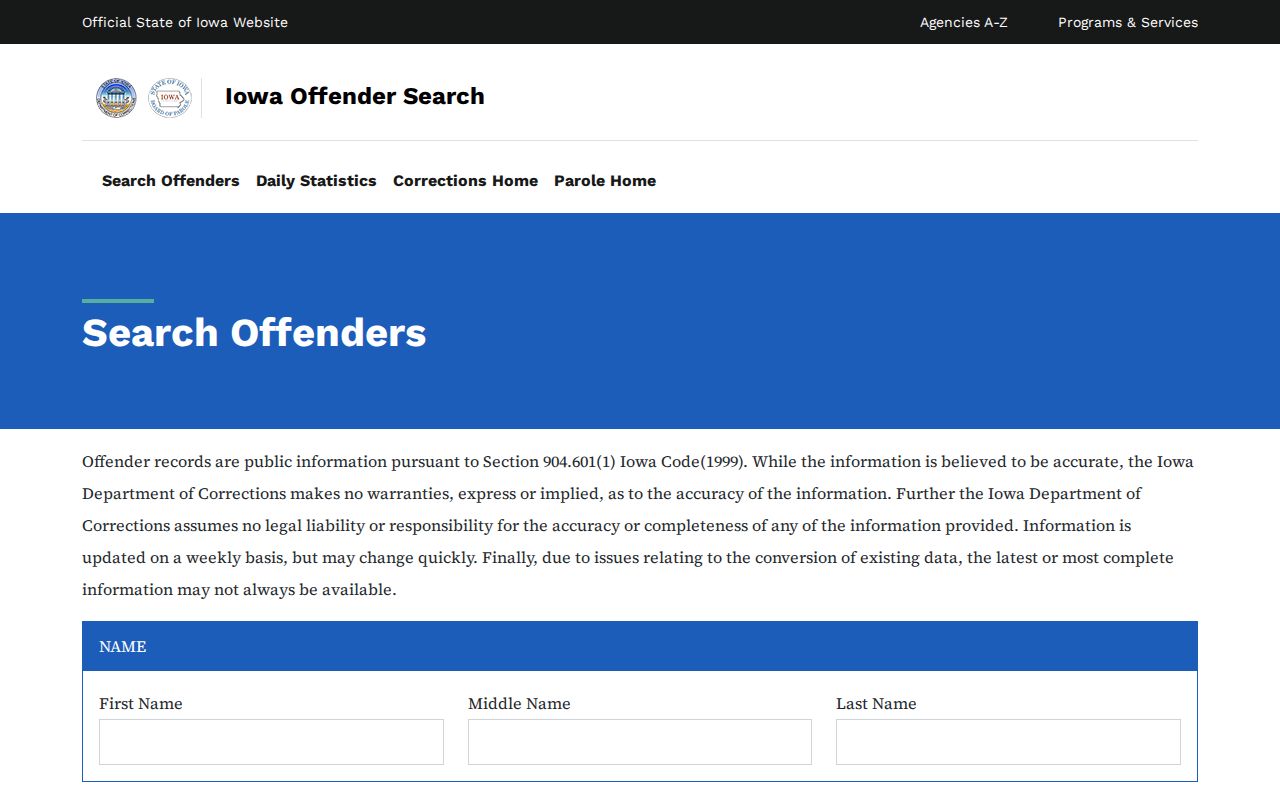
Confirm time-sensitive status with corrections. Iowa VINELink can add custody or release notices, but it is not a full probation file. The Iowa Board of Parole handles parole decisions, and detailed supervision notes should not be assumed public.
Hancock County Criminal Records by City
Garner, Britt, and Kanawha are the county's three largest incorporated cities by the official 2020 Census counts, and each has its own police function. A city-created incident report stays with that city. Booking data runs through Hancock County, while every local criminal or ordinance court case enters Iowa's unified District Court system. None of the three cities has a municipal court or its own court portal.
Garner Criminal Records
3,065 residents · City police reports begin with Garner, while court files are kept by the Hancock clerk.
Britt Criminal Records
1,707 residents · Britt Police keeps city incident material; county systems hold booking and court records.
Kanawha Criminal Records
658 residents · Confirm current police staffing with the city before making a records visit.
The population figures are 2020 Census counts, not current estimates. For any city, request the incident file from that police department, then use county systems for booking and court verification.
Correcting Hancock County Criminal Records
Begin an error review with the source. If the docket has the wrong outcome, ask the Hancock clerk about the filed order and case record. If the DCI history is wrong, use the DCI criminal-history unit's dispute process and describe the entry. DCI may ask for fingerprints to confirm identity. A completed deferred judgment can remain in DCI data as discharged even after the court record is expunged, with release governed as nonconviction data.
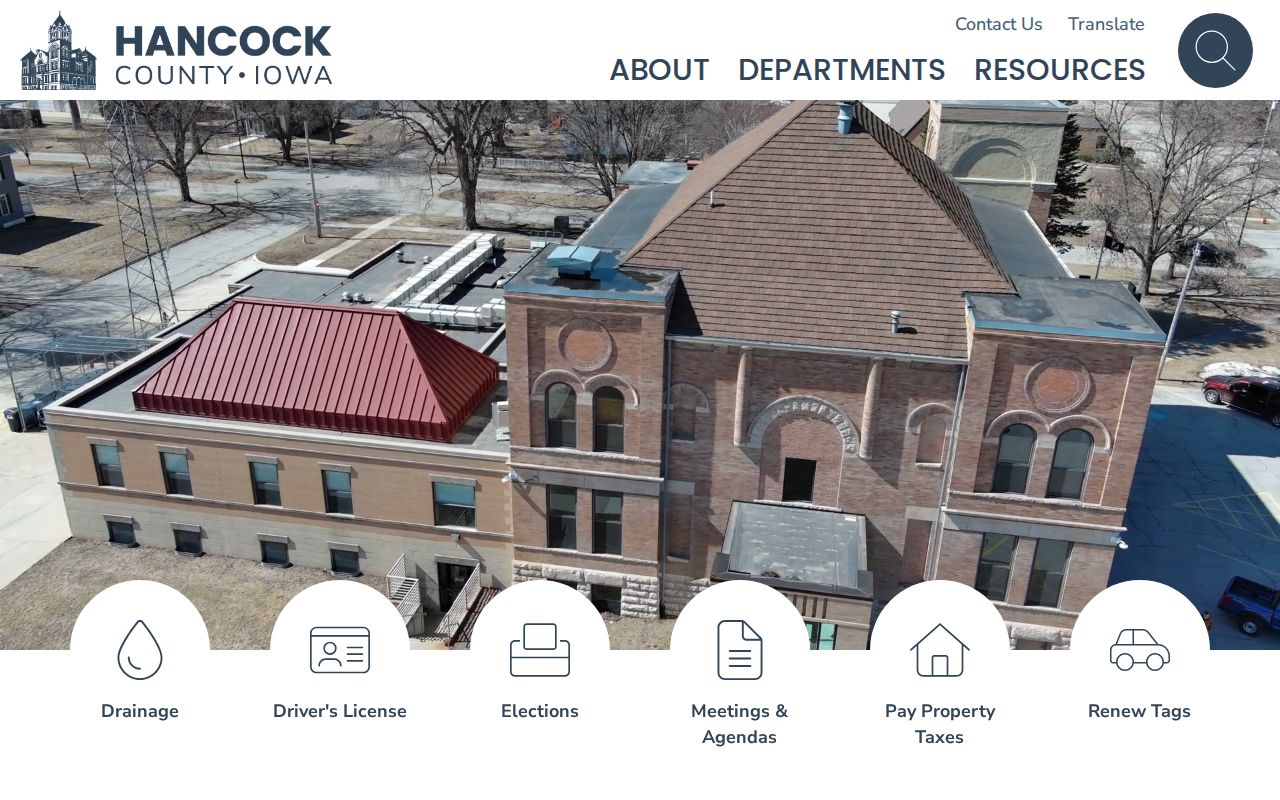
The official Hancock County homepage shown here routes readers to the courthouse, sheriff, attorney, and other local custodians.
Ask for a fee estimate before requesting a large file. The sheriff publishes several useful prices, but the list does not establish a blanket criminal-history or certified-court-copy fee.
| Hancock or Iowa service | Published amount |
|---|---|
| Sheriff paper copy or fax/email print | $0.50 per page |
| CD, DVD, or flash-drive copy | $15 |
| Applicant fingerprint card | $10 per person |
| DCI name-based record check | $15 per last name |
| Iowa Courts Online Advanced Search | $25 per month |
The sheriff's official page gives the local office context for copies, fingerprints, booking, and law enforcement records. Confirm which fee and format apply before payment, since court copies and DCI checks follow their own schedules.