
Hancock County Criminal Court Cases
The Iowa District Court for Hancock County hears criminal matters filed in the county. Felonies and serious or aggravated misdemeanors proceed within the District Court. Magistrates and other judicial officers in the same unified system also handle simple misdemeanors, traffic cases, and ordinance matters. Iowa abolished separate municipal, mayor's, and police courts through its unified-court structure. As a result, there is no independent Garner, Britt, or Kanawha municipal criminal docket to search.
The Clerk of Court maintains Hancock County criminal case files at 855 State Street, Garner, Iowa 50438. Call 641-923-2532 before a records visit. County materials place the clerk on the second floor, yet a separate fine-payment answer refers readers to the third floor. The safest course is to confirm the right counter. Courthouse hours are Monday through Friday, 8:00 a.m. to 4:00 p.m., except posted holidays. Hancock is in Judicial District 2A, and published schedules rotate judges across Hancock and Winnebago court days.
Hancock County Online Court Docket
Iowa Courts Online is the free first stop for a Hancock County criminal case. It requires no account and offers statewide electronic docket access. Select Hancock County when searching by name. A case ID or full citation number gives a more exact path when available. Name-only matches need care because the public index may return people with similar names.
The official landing screen shows the statewide entry point used for Hancock County criminal records.
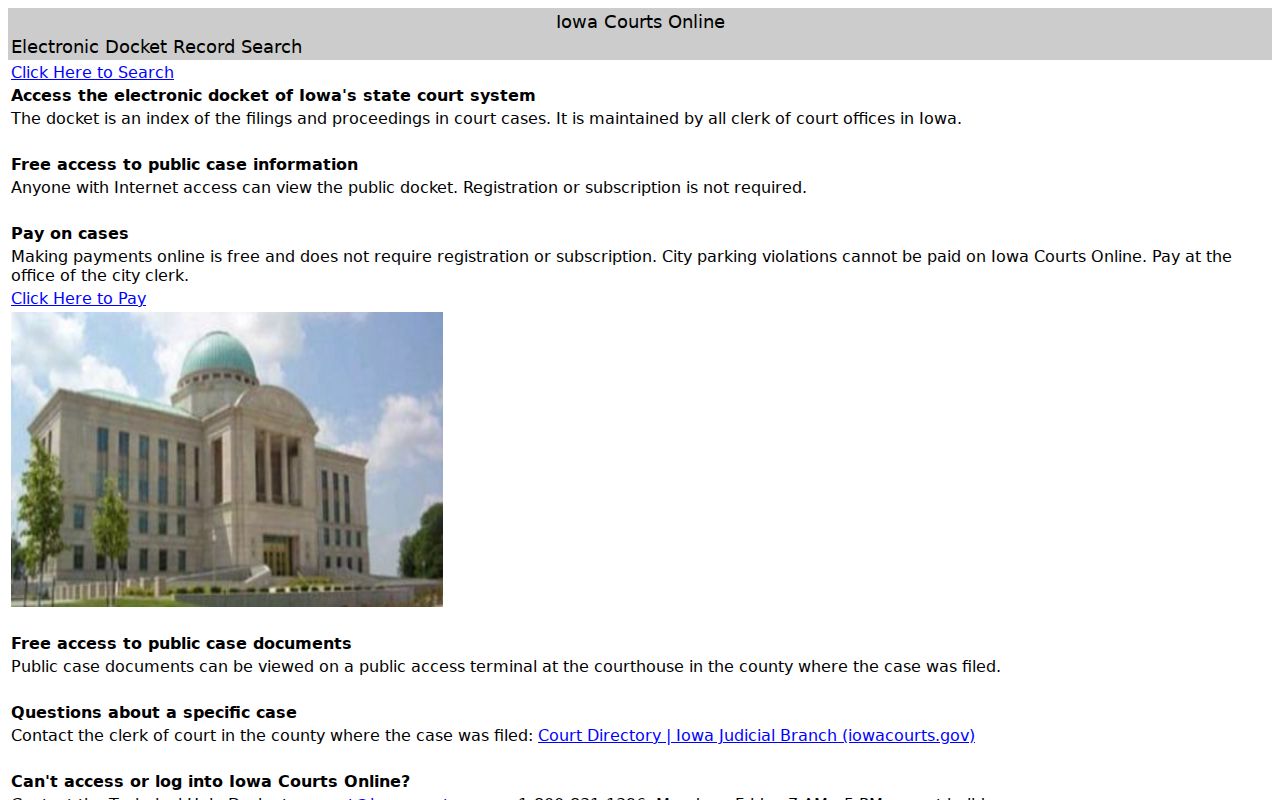
The image reinforces an important limit: the online service is a docket index, not a complete online document room. Confirm the county, case title, charge type, dates, and status before treating a result as the intended case.
Searching Hancock County Case Records
Use the free docket before paying for broader search tools. The public path supports name, case ID, and citation searches. It also provides a county filter. Search terms should be specific enough to reduce false matches, but alternate spellings may help when no result appears. Citation data can take 14 to 21 days to post, so a missing recent entry is not final proof that no court record exists.
- Open Iowa Courts Online and choose the name path or the case/citation-number path.
- Enter at least two characters of the first and last names, then narrow the results to Hancock County.
- Use the complete Case ID or citation number when known. A partial citation path accepts the last four to six digits.
- Open the docket and compare its title, county, charges, filing date, and event sequence. Read each count on its own.
- Ask the Hancock clerk for public pleadings, orders, judgments, or plain and certified copies that the online index does not display.
The public case and payment search exposes the actual controls used for many court and citation lookups.
| Field Label | Type | Required | Use |
|---|---|---|---|
| Search path | Tab or radio | Choose one | Name or case/citation number |
| Case Type | Dropdown | Not stated | Choose criminal or traffic where apt |
| County | Dropdown | Narrowing field | Select Hancock |
| First and Last Name | Text | Name path | At least two characters of each |
| Partial Citation | Text | Alternative | Last four to six digits |
| Case ID or Citation | Text | Alternative | Enter the complete identifier |
The official public-search screen shows why a county filter and exact identifier are stronger than a broad name search.
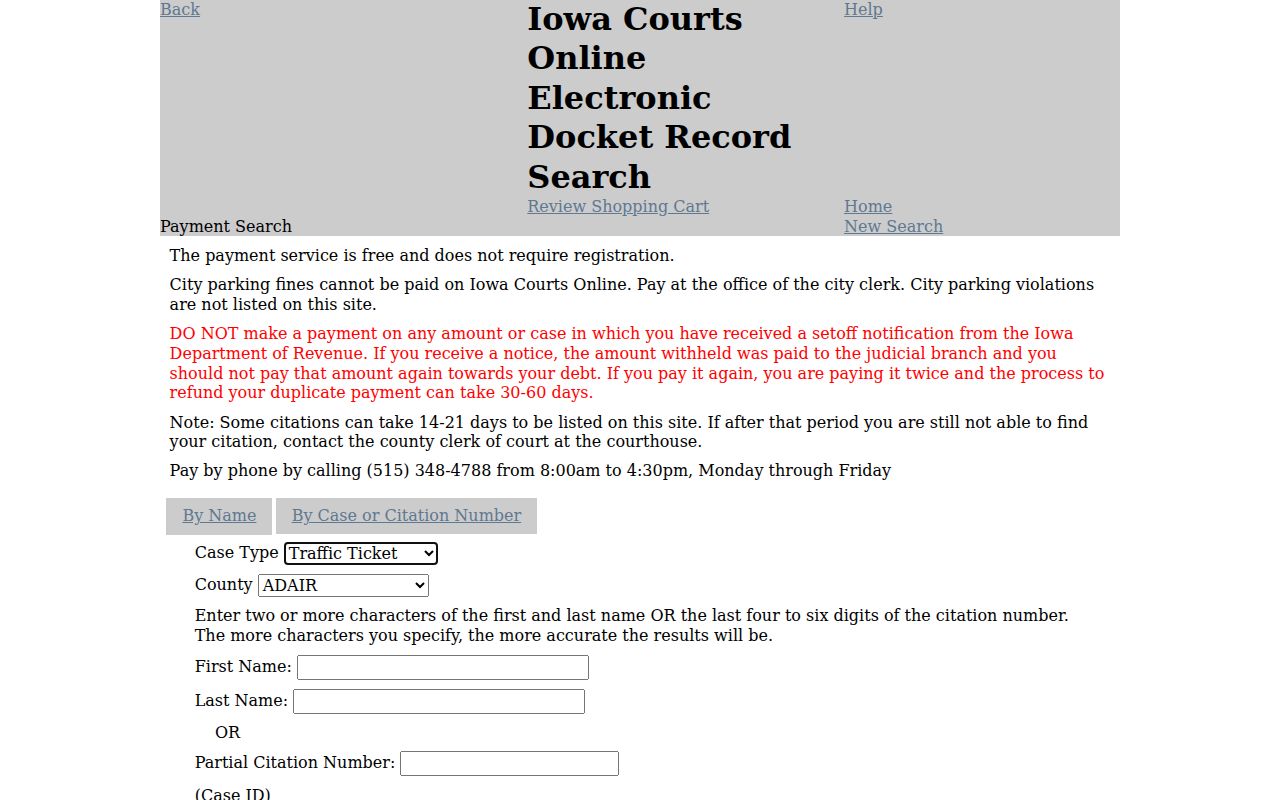
When a result is absent after the posting window, call the clerk rather than assuming the citation or case does not exist.
Note: City parking fines do not appear in the Iowa Courts Online payment function, although criminal and traffic matters use the unified court system.
Hancock Court Documents Stay in Garner
Remote search and document access are separate channels. Iowa Courts Online shows docket descriptions, case events, and public metadata. The filing courthouse provides free access to public case documents through its terminal. Readers who need the complaint, trial information, motion, order, judgment, or sentencing paper should use the terminal or request copies from the Hancock clerk. Call first for archived matters, certification needs, costs, and the correct floor.
The optional Advanced Case Search costs $25 per month. It expands searches involving parties, schedules, judgments, liens, exhibits, service, traffic, and financial data, but it still does not display document images. Paying for access does not turn the portal into a copy service.
The official subscription login illustrates the expanded search tier available for Hancock County court records.
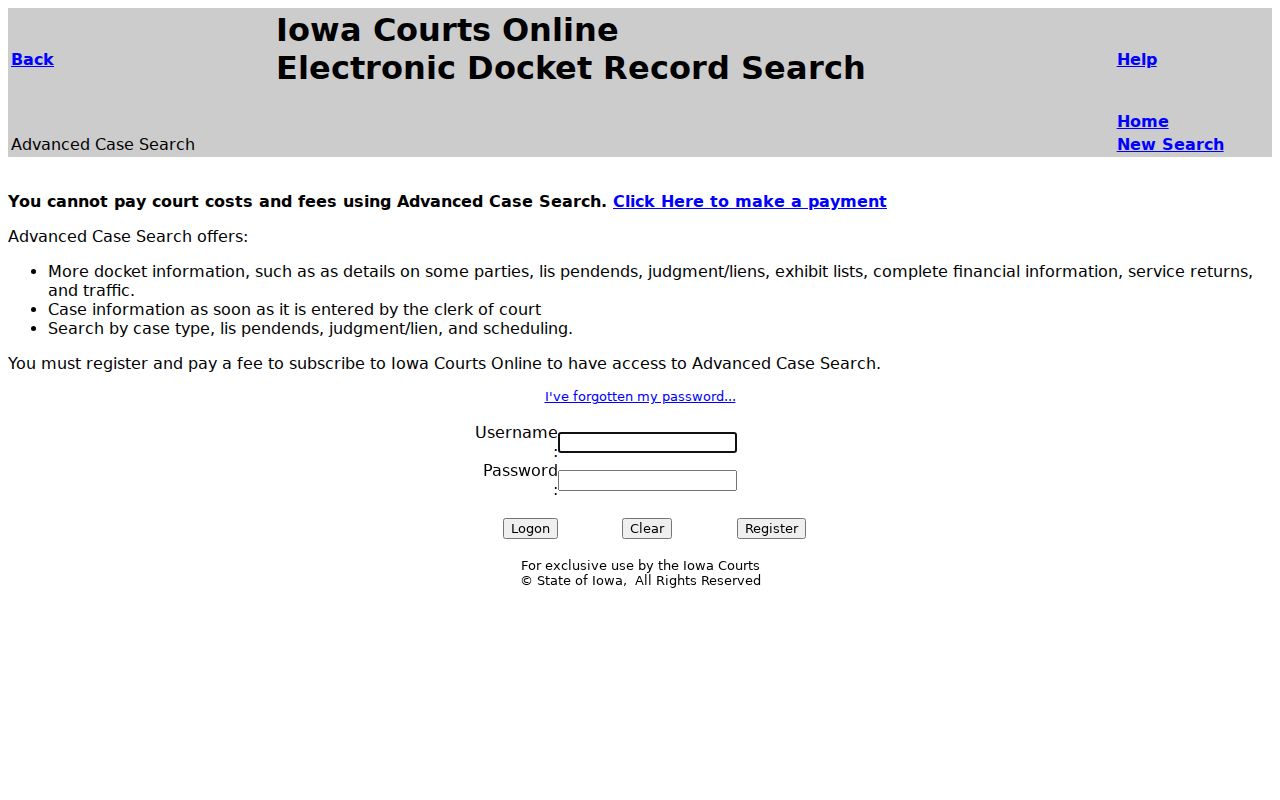
The clerk remains the source for the filed paper or electronic document behind a docket description.
Inside a Hancock County Case File
A Hancock County criminal case file records prosecution, not merely custody. The public docket can identify the case and its progress. Filed documents add the allegations, arguments, rulings, and final terms. Review each charge because one count may be dismissed while another ends in a plea or judgment. Financial entries may include public costs, fines, surcharges, restitution, and payment data.
| Case Header | Case ID, title, Hancock County, case type, filing date, and status. |
|---|---|
| Parties | State of Iowa, defendant, and attorneys when entered. |
| Charging Record | Complaint, trial information, or indictment, plus statute and degree or class. |
| Docket Events | Appearances, pleas, motions, hearings, orders, warrants, and financial events. |
| Disposition | The result of each charge, such as conviction, dismissal, acquittal, or another status. |
| Sentence | Judgment, custody or supervision terms, and public financial obligations. |
| Documents | Descriptions online; public images at the filing courthouse terminal. |
A disposition means the outcome of a charge. It should not be inferred from an arrest, bond entry, or early hearing. The court's later entry controls.
Hancock Charges and Clerk Records
The Hancock County Attorney decides which state charges to pursue. Rachel Martinez's office is at the courthouse and prosecutes both indictable and non-indictable matters. It may file a complaint or trial information and take part in hearings, plea work, trial, and sentencing. The prosecutor is not the neutral custodian for certified case copies. That task belongs to the clerk.
The county's published criminal process also corrects a common mistake. A complaining witness does not control whether the State drops a charge. The County Attorney represents the State and makes prosecution decisions under court procedure. A represented defendant should communicate through counsel because the county FAQ notes that ethical rules prevent the prosecutor from speaking directly with that person. Court-appointed defense is handled through Iowa's court and State Public Defender system, not through the prosecutor.
How a Criminal Case Moves
Hancock County describes a case as a sequence that starts with investigation and may continue through appeal. An arrest is not required in every case because a citation can also start the path. The prosecutor reviews the facts and decides whether to file. An initial appearance addresses the charge, rights, counsel, bond, and release. Arraignment is the stage at which the formal charge is stated and the plea is addressed.
Case flow: Investigation or arrest › Charging decision › Initial appearance › Arraignment › Pretrial motions › Plea or trial › Disposition › Sentencing › Possible appeal
Pretrial entries can include discovery disputes, scheduling, motions, and plea negotiations. A trial ends in a verdict, while a plea resolves the charge without trial under court procedure. Judgment and sentence follow a conviction. Later probation-violation or warrant events may appear on the same docket or a linked matter. The full Hancock County arrest lookup addresses the separate incident, booking, and custody records that precede many court cases.
Reading Hancock Criminal Dispositions
Docket terms have distinct meanings. A dismissal ends a charge without a conviction on that count. An acquittal is a not-guilty result after trial. A conviction follows a guilty plea or verdict and leads to judgment. Iowa also uses deferred judgments, which postpone entry of judgment while court conditions are completed. Their court treatment and release through the state repository differ from a standard conviction.
- Arraignment
- The proceeding where the formal charge is stated and a plea is addressed.
- Docket
- The date-ordered index of filings, hearings, orders, and other case events.
- Disposition
- The result or current outcome of a specific charge.
- Trial information
- An Iowa prosecutor's formal charging instrument for an indictable offense when allowed.
- Deferred judgment
- An Iowa procedure that delays judgment while a person completes stated conditions.
Always read charge by charge. A docket with several counts can show a mix of dismissed and resolved allegations. A header status alone may not explain every count.
Federal Cases Beyond Hancock Court
Federal criminal cases from Hancock County do not appear as state court prosecutions. The county falls within the U.S. District Court for the Northern District of Iowa, while federal dockets and filed documents use PACER. Registration and the current federal fee rules apply. A DCI-only history is also not a substitute for a federal court search.
The Northern District of Iowa supplies the official federal court layer for local readers.
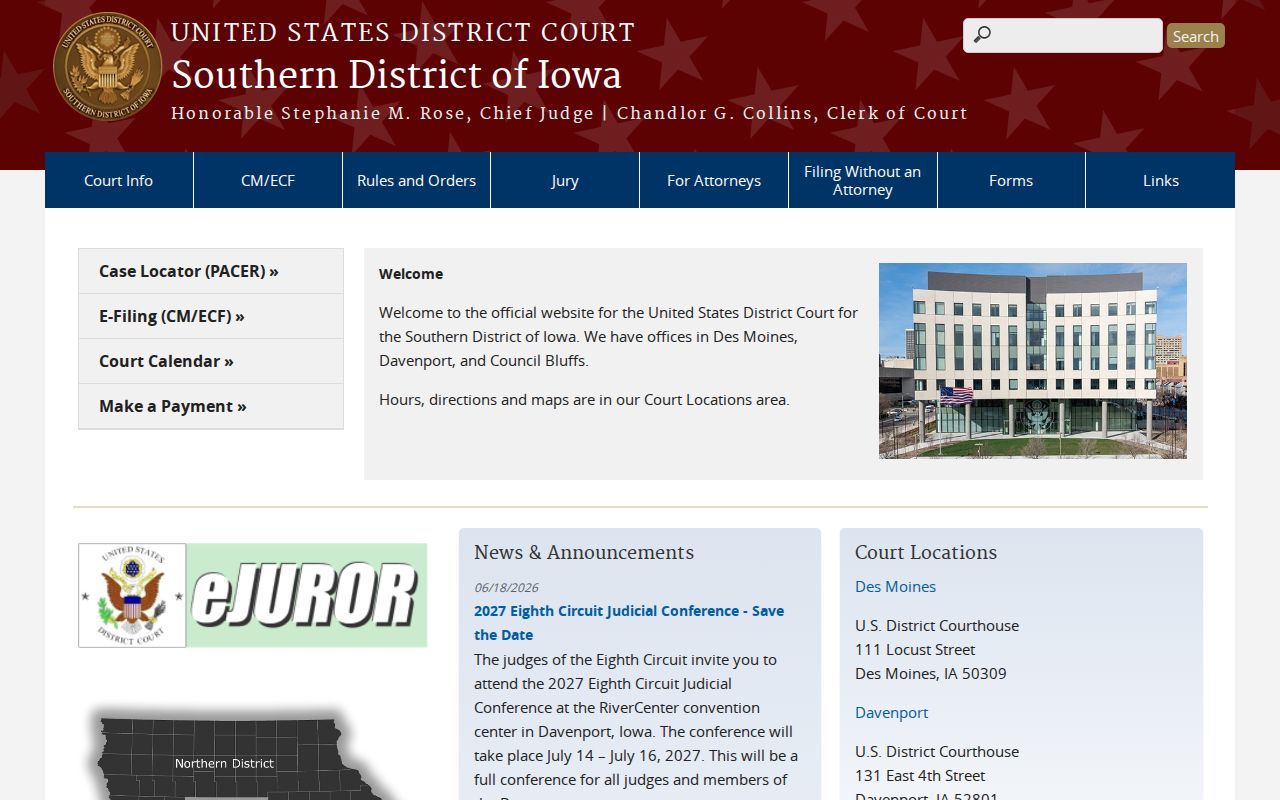
This federal channel is separate from Iowa Courts Online and the Hancock clerk. Use the court that actually filed the case.
Case Record Access & Restrictions
Iowa Code chapter 22 supports examination and copying of public records, but it does not make every justice record unrestricted. Judicial Branch access rules govern court files. Juvenile material is generally confidential. Expunged cases, sealed documents, protected identifiers, victim information in sensitive matters, medical details, and active investigative content can be withheld or redacted.
Online redaction does not imply that every hidden item is available at the counter. Ask the clerk whether a public document exists and request segregable public portions when a filing mixes open and confidential material. Under Iowa Code chapter 901C, qualifying records can become confidential through expungement. If a known case is missing, confirm the spelling, county, filing lag, and case number before asking whether a confidentiality rule applies.
Note: A public case docket may show a charge that a DCI response omits because court access and repository dissemination follow different rules.