
Sex Offender Checks in Hancock County
The official starting point is the Iowa Sex Offender Registry, operated by the Iowa Department of Public Safety, Division of Criminal Investigation. It offers the broadest public view for Hancock County because searches can start with a name or a location. The registry also makes clear that its public site does not contain the entire list of people required to register. A search with no result is not proof that no registrant lives, works, or spends time in the area.
Use a precise name when one is known. For a neighborhood check, select Hancock County or use a city, ZIP code, or address search. Garner, Britt, and Kanawha can narrow the view, but city boundaries and postal labels can make an address search useful too. Open the full public profile before drawing any conclusion from a result list. For a record that appears stale, a suspected compliance issue, or a question about local registration, call the Hancock County Sheriff's Office rather than guessing from a map marker.
The registry's own public notice and entry screen shows the terms a searcher must accept.
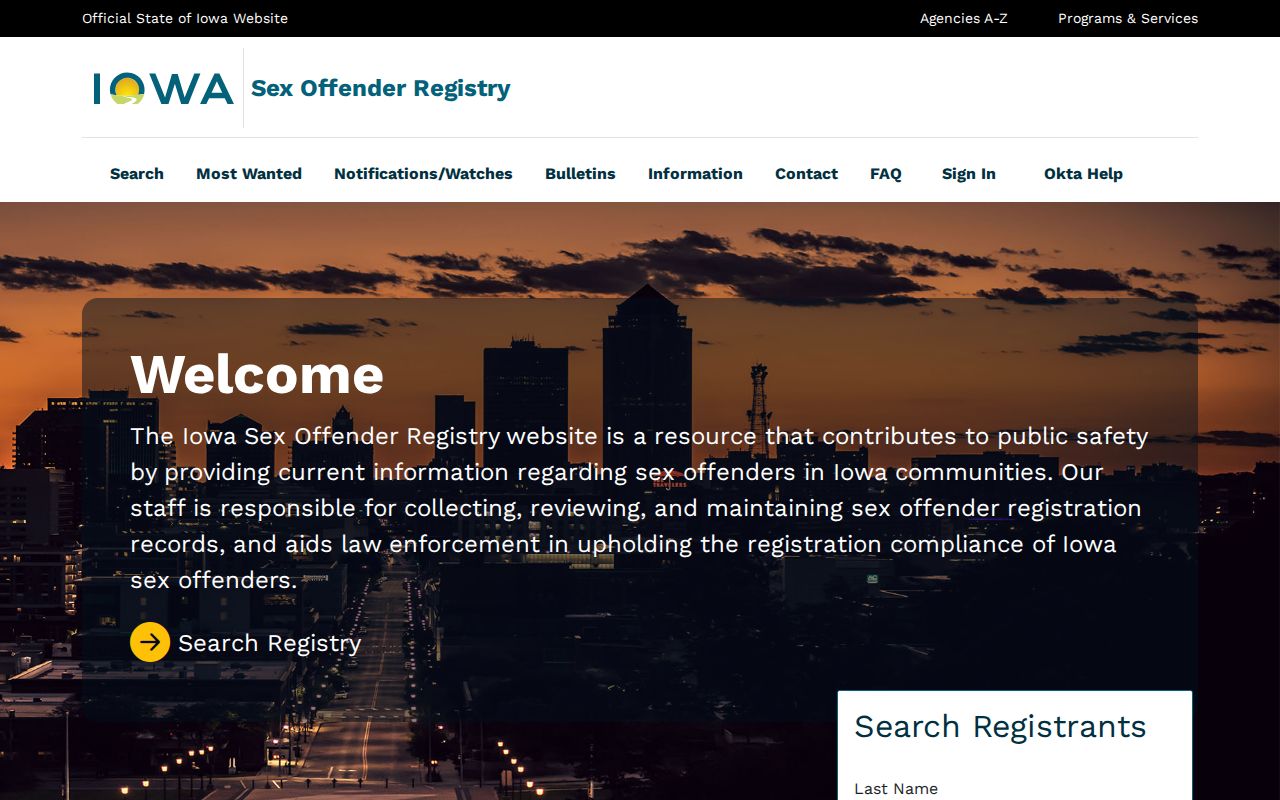
That notice sets the right frame for every Hancock County registry search: public access is useful, but the displayed list has legal and data limits.
Hancock Registry Notice Limits
The most common mistake is treating the public list as a census of every person who has any registration duty. Iowa law controls which people and which fields are public. Some information held by law enforcement is not placed on the public site. The portal also warns that information may not be fully accurate or complete. A user should therefore compare the name, physical details, status, offense information, and location shown in the profile instead of relying on a pin or a surname alone.
Hancock County residents can resolve a local question through the sheriff's office, while statewide record questions go to DCI's registry office. The state contact is at the Oran Pape State Office Building, 215 E. 7th Street, Des Moines, Iowa 50319; telephone 515-725-6050; email sorinfo@dps.state.ia.us. Those channels are especially useful when a profile appears to conflict with a known address or when a technical search issue prevents a sound match.
How to Search the Iowa Sex Offender Registry
The Iowa registry offers basic, advanced, and geographic paths. Start broad enough to catch a spelling variation, then narrow the set. A location search is not the same as a name search, and the registry's newer watch tools serve a different purpose from a one-time lookup.
- Open the official registry and read the public-use notice. Select “Agree to Terms” to enter the search tools.
- Choose a name search or a place search. Enter a surname and first name when known, or select Hancock County, a city, ZIP code, or address and radius.
- Review the result list or map. Compare more than one identifier and open the full profile for the current public details.
- Save the official profile reference, then contact DCI or the Hancock sheriff if the record looks wrong, stale, or tied to suspected noncompliance.
The official basic-search screen shows the name and ZIP controls without focusing on a private individual.
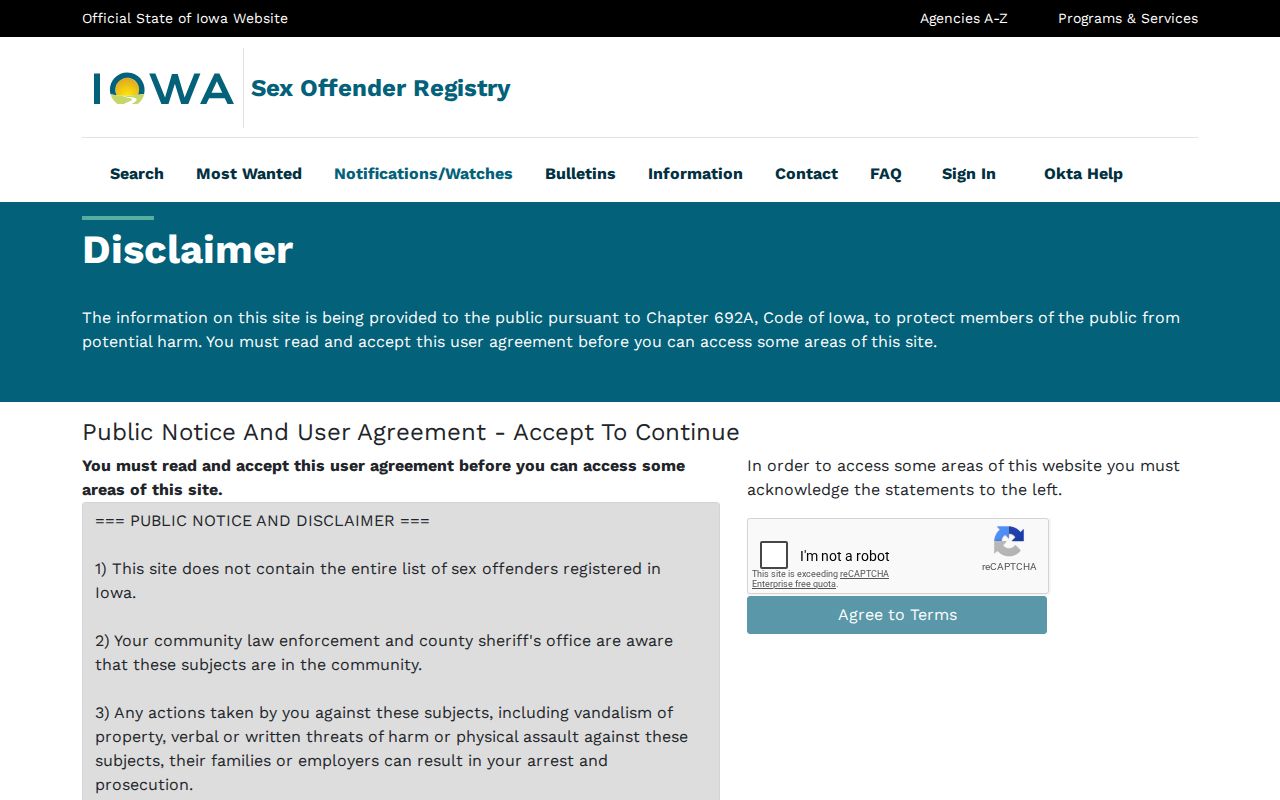
The form supports a focused Hancock County check while the alias option helps when a person has used more than one name.
| Field Label | Type | Required | Use |
|---|---|---|---|
| Agree to Terms | Button | Yes | Accepts the public notice before searching |
| First Name | Text | No | Narrows a registrant name search |
| Last Name | Text | No | Main name-search field |
| Also Search Aliases | Checkbox | No | Includes known public aliases |
| City / County / ZIP | Text or select | No | Narrows results to Hancock County places |
| Address and Radius | Text and select | For radius path | Creates a geographic search area |
| Map / List | View control | No | Changes the result display |
Hancock Sex Offender Search Fields
The advanced and geographic controls help when a basic name search is too broad. The live portal should control any radius choice because those options can change. Do not invent a distance or assume that a map circle follows a city line. The 2025 registry relaunch also added watches for an address and radius, city, county, ZIP code, or a specific registrant. A free account can send email after registered information changes.
The official advanced-search view documents the expanded geographic controls available for Hancock County.
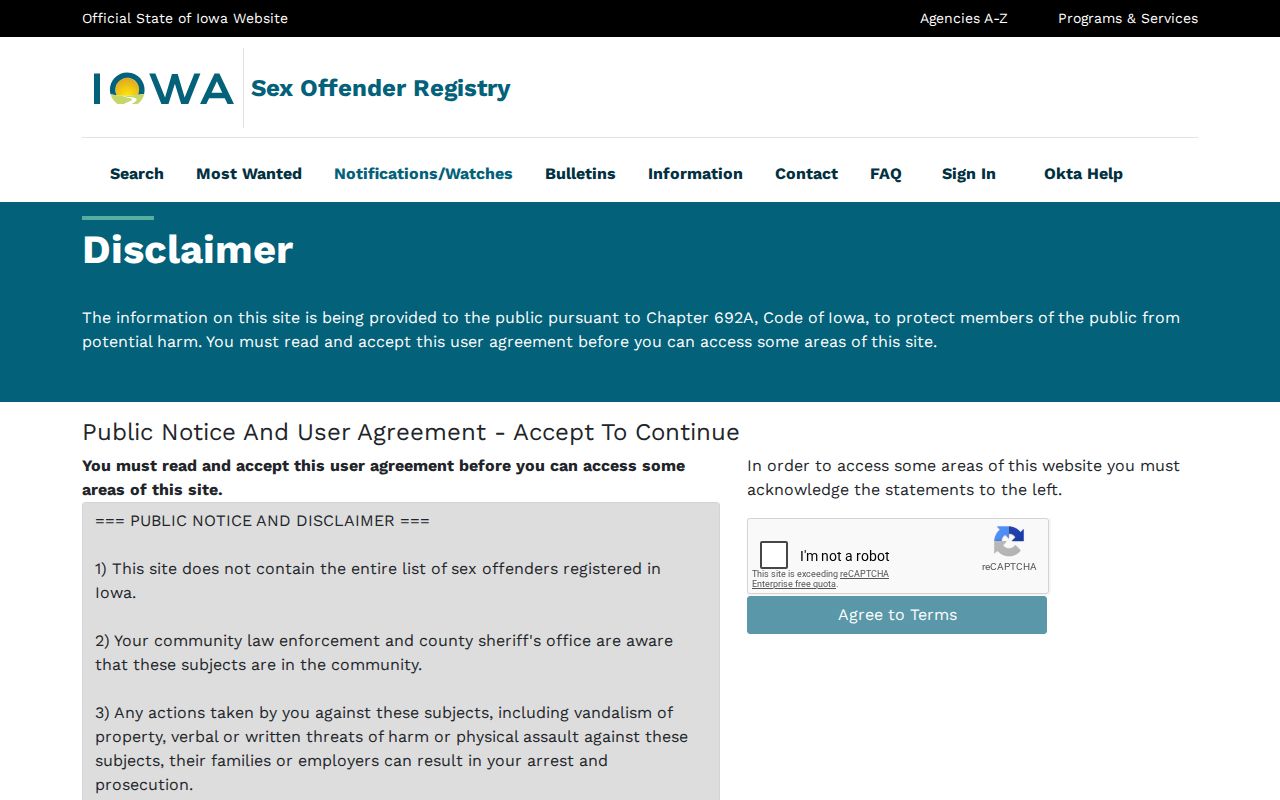
These controls are best used to refine a search, not to claim that everyone with a legal duty appears within one map view.
Inside a Registry Profile
An Iowa public profile groups identity, location, status, and qualifying-offense facts that chapter 692A permits for release. Not every profile displays every field. The public record can change as a person reports new information or DCI updates the system, so note the status and update context shown on the official profile.
| Name and Aliases | Public identity names used to distinguish a match. |
|---|---|
| Photo and Description | A photograph and allowed details such as sex, race, height, weight, hair, eyes, scars, marks, or tattoos. |
| Location Information | Address or other location details that chapter 692A makes public. |
| Qualifying Offense | Offense, jurisdiction, and conviction information released for the registration record. |
| Registration Status | Registration, compliance, and related status information available to the public. |
| Other Public Fields | Vehicle, school, work, or temporary-location information when Iowa law authorizes publication. |
Victim identity, Social Security number, fingerprints, DNA, identity documents, and protected nonconviction arrest data are not public profile fields. A registry profile is also not a court file. The qualifying conviction and its case history should be read through the court that entered it.
Hancock Registry and NSOPW Compared
The Iowa registry is the direct source for state records and offers Iowa-specific search modes, watches, and contact routes. The National Sex Offender Public Website is a federal search layer that queries participating public registries across jurisdictions. NSOPW is useful when a search may cross state lines, but it does not replace Iowa's profile or the Hancock County sheriff's local knowledge.
The national site's search and safety notice illustrates that cross-state layer.
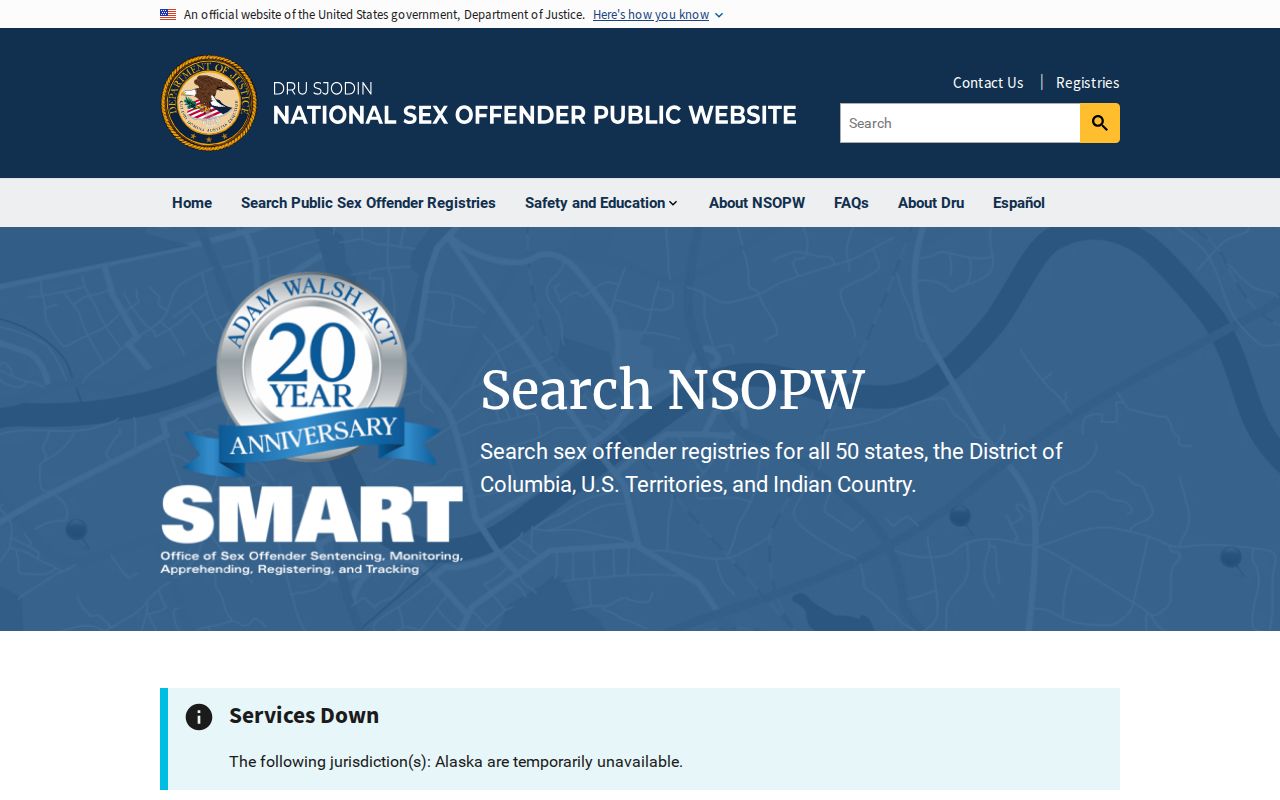
For a Hancock County match, return to the Iowa profile for state details and use local law enforcement for a time-sensitive compliance concern.
Searches serve different questions. Iowa gives the most direct state record. NSOPW broadens geography. The sheriff addresses local registration and suspected violations. Police or 911 should handle an immediate safety threat, not a registry email or a public confrontation.
Iowa Registration Levels and Requirements
Iowa does not use a simple public label in which Tier I always means ten years, Tier II means twenty-five years, and Tier III always means life. Chapter 692A ties duration to the offense and legal status. Under the 2026 framework, the baseline period is ten years. A chapter 903B special sentence carries registration for that sentence, but never less than ten years. Revocation may restart time, and a chapter 692A violation adds ten years. A later registering conviction, aggravated offense, prior registering offense, or sexually violent predator status can lead to life registration.
| Verification Tier | General Appearance Cycle | Duration Rule |
|---|---|---|
| Tier I | Generally once each year | Offense and status control; not a fixed tier duration |
| Tier II | Generally every six months | Offense and status control; not an automatic 25-year rule |
| Tier III | Generally every three months | Offense and status control; lifetime may apply under listed grounds |
Section 692A.108 sets the usual appearance cycle and requires at least an annual photograph. Section 692A.106 controls duration, including rules for another jurisdiction's longer period. Section 692A.128 provides a modification path for eligible people. These rules need a case-specific reading of the current statute, not a conclusion drawn from a tier label alone.
Hancock Registration at 875 State
Jail Administrator Kevin Knebel assists with sex offender registration through the Hancock County Sheriff's Office. The office is at 875 State Street, Garner, and can be reached at 641-923-2621 or 641-924-2148. The sheriff's published fee list posts a $25 registration fee. Iowa Code section 692A.110 treats it as an annual fee and permits installments, added time, or waiver when a person cannot pay.
No separate public registration schedule is posted. Call for the current appointment and verification procedure rather than assuming that general office hours set every reporting time. The sheriff also performs duties under section 692A.120 and provides local follow-up when DCI registry information raises a compliance question.
Hancock County Registration Contact
Hancock County Sheriff's Office
875 State Street
Garner, IA 50438
641-923-2621 or 641-924-2148
Call for current registration and verification arrangements.
Hancock Sex Offender Residency Rules
Iowa Code section 692A.114 restricts a registrant convicted of an aggravated offense against a minor from living within 2,000 feet of school or child-care real property. The statute contains exceptions, including some preexisting residences and institutional or health circumstances. A map estimate is not a legal measurement. Current facts and the exact statutory category must be checked before anyone reaches a conclusion about compliance.
The sheriff gives school administrative offices the notices required by section 692A.121. Public awareness also runs through the searchable registry and its watch service, rather than through a single flyer process. Suspected noncompliance should be reported to Hancock law enforcement with the location and reason for concern. Members of the public should not try to detain, confront, or investigate a person.
Community Notification and Lawful Use
Registry information is intended for awareness and safety planning. Check the source record, account for the site's stated limits, and share concerns with the agency that can verify them. The public should not use a profile to threaten a registrant, target a household, or organize vigilantism. When a danger is immediate, call 911. For a nonurgent Hancock County compliance concern, contact the sheriff. For a state-data error, contact the DCI registry office.
Misuse warning: Iowa Code chapter 692A prohibits using registry information to harass, threaten, or intimidate. Misusing the public data can be a crime.
The same restraint applies when a record appears out of date. Preserve the official link and the facts that seem inconsistent, then send them to DCI or the sheriff. A public search result is not permission to make contact. It is a prompt to use official channels and act within Iowa law.